
Yuri: Ben, we are rolling.
Ben: Perfect. Hi, I’m Ben, and I’m here with Yuri from iBathrooms. We’re looking at a recent bathroom renovation in Barrhaven. The before photo shows a very classic older bathroom: blue floral tile, old tub, and then there’s that shower cap photo. Yuri, take me right back to the start. What sort of bathroom was this before?
Yuri: So, uh, an example of a typical three-piece bathroom renovation. Very, very similar, from the footprint and square footage of the bathroom, to the materials that it is made of, to the final outcome that people want. Initially it’s a tub-and-shower combination, so you can use it as a tub, you can use it as a shower, which works for younger families, with younger kids specifically. But as you get older, it becomes difficult. The flooring was done in this very economical roll vinyl — again, we’re talking about an existing bathroom — which surprisingly kept in decent shape for the age of the bathroom. It’s an original bathroom from the 1980s, with your basic built-in-place 36-inch vanity. So everything was working, but it was not working for our customers.
Ben: Right, so not falling apart, but no longer working for the people living there. What was actually making it hard for them?
Yuri: So, um, as people age — and these are the original homeowners of the house — it became difficult for them to get into the tub/shower. They were probably in their 70s. Like, to be honest with you, any time I talk about people’s age, call somebody young or call somebody elderly, part of me cringes because on the inside I hope that we’re all 21. But when it comes to the physical time and space and life that we live in, at some point it catches up with us and we find that we’ve aged. For these particular folks, it was simply difficult to get inside the tub — almost impossible because of that height. It’s 15.5 to 16 inches tall, and they needed to have a shower. So the decision was: let’s do the entire bathroom, but the focus is to convert the tub into an easy-to-get-into, safe, comfortable shower.
Ben: That makes total sense. So when you say “easy to get into,” what did that mean for this specific shower? What did you put in, and what did you take out?
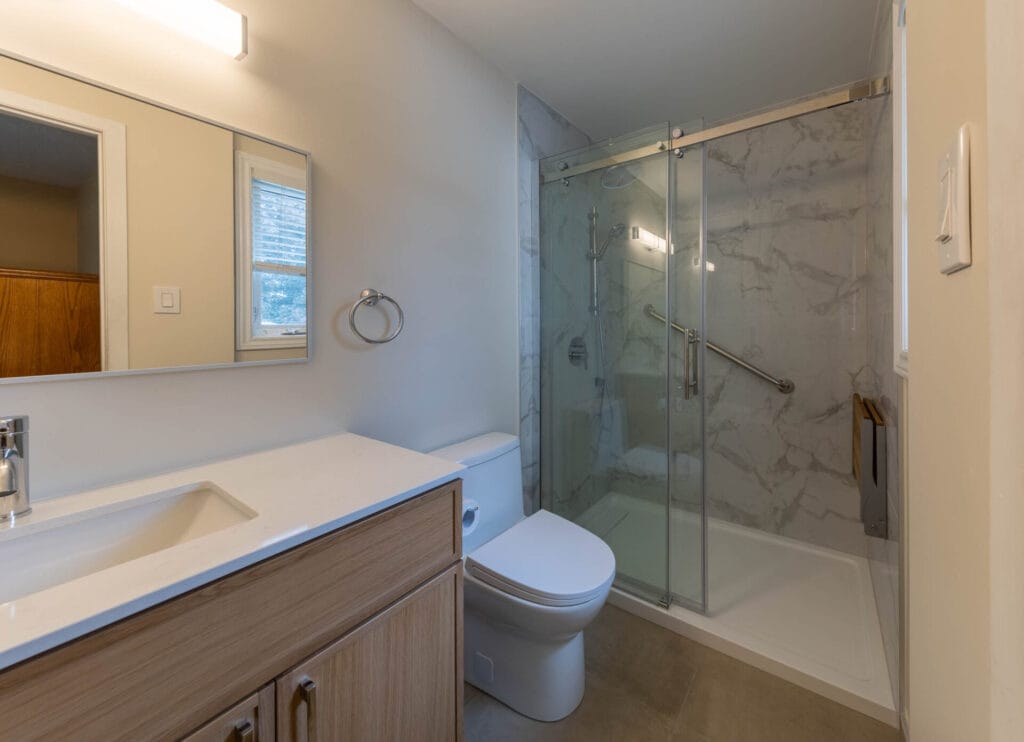
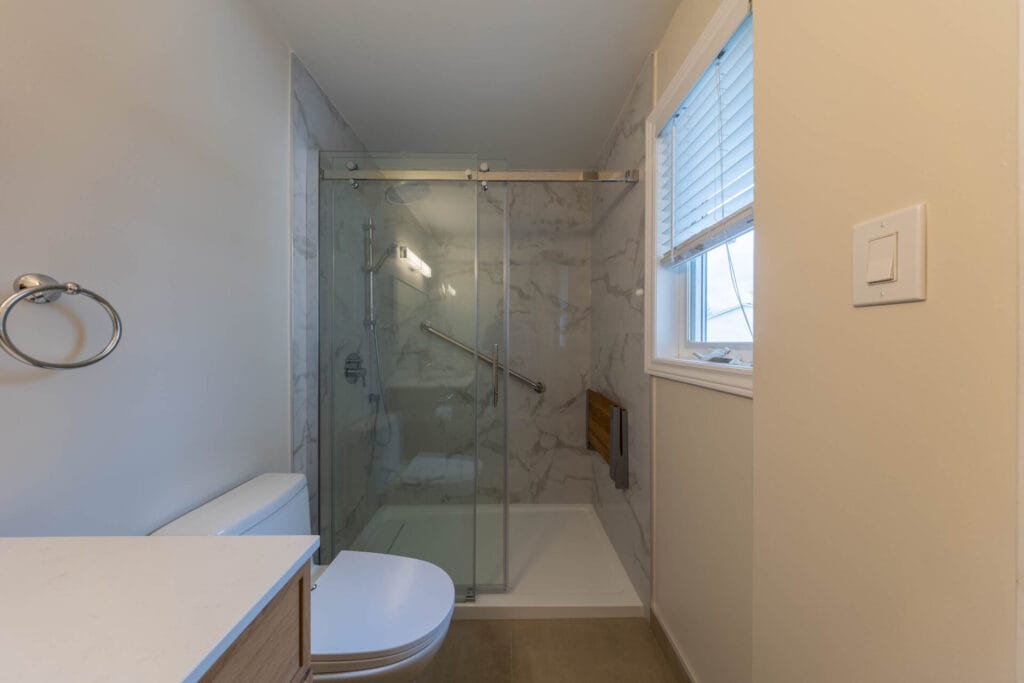
Yuri: So there’s two levels that we can describe as easy to get into. There is a level where an individual — elderly or perhaps physically disabled — can still raise a foot roughly two to three inches. We can go into the details, but there are various ways of doing showers. Some showers will have a threshold, also known as a shower ledge, a little lip that you step over to get into the shower area. Some showers are barrier-free — it’s a completely different animal. For some people, being easy to get into means they’re using either a walker or a wheelchair, which requires a barrier-free shower. Different animal, different conversation. Perhaps we can have that conversation at a different time. For these folks, easy to get into means we don’t have to raise our foot over 16 inches to step in; two inches is enough. Some shower bases come with a higher threshold. I personally do not like them. I feel that they defeat the purpose. So in this case, it was roughly a two-inch shower threshold to step over, then they’re inside the shower. And inside the shower, we wanted to make sure that the shower base is non-slippery, which is the type of shower base we provided. We wanted to make sure that they have a grab bar, so in case they need to hold on to something. And we wanted to make sure that they can have a seat. Again, we can go into the technicalities, but usually with an acrylic shower base, you do not build the seat on top of it. That’s for custom tile showers. You can put a chair in there, but I don’t like putting a chair on an acrylic base. So the fold-down seat by Moen was an excellent choice — built into the wall, supported with the studs and bracing underneath. It works wonders, and you can get it out just by a flip of a finger.
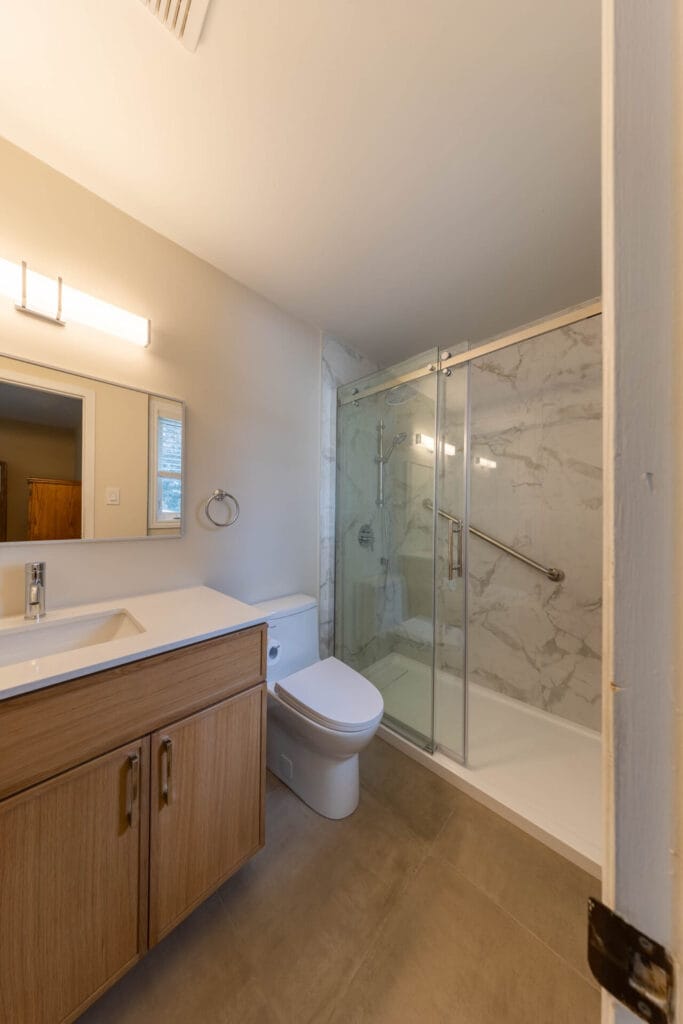
Ben: Right, so low threshold, non-slip base, proper grab bar with blocking, and a fold-down seat anchored safely. That’s all the stuff that you can’t really see now. Looking at the finished photos, can you describe what I’m looking at? Because it’s bright, it’s clean, there’s glass, there’s what looks like marble but isn’t.
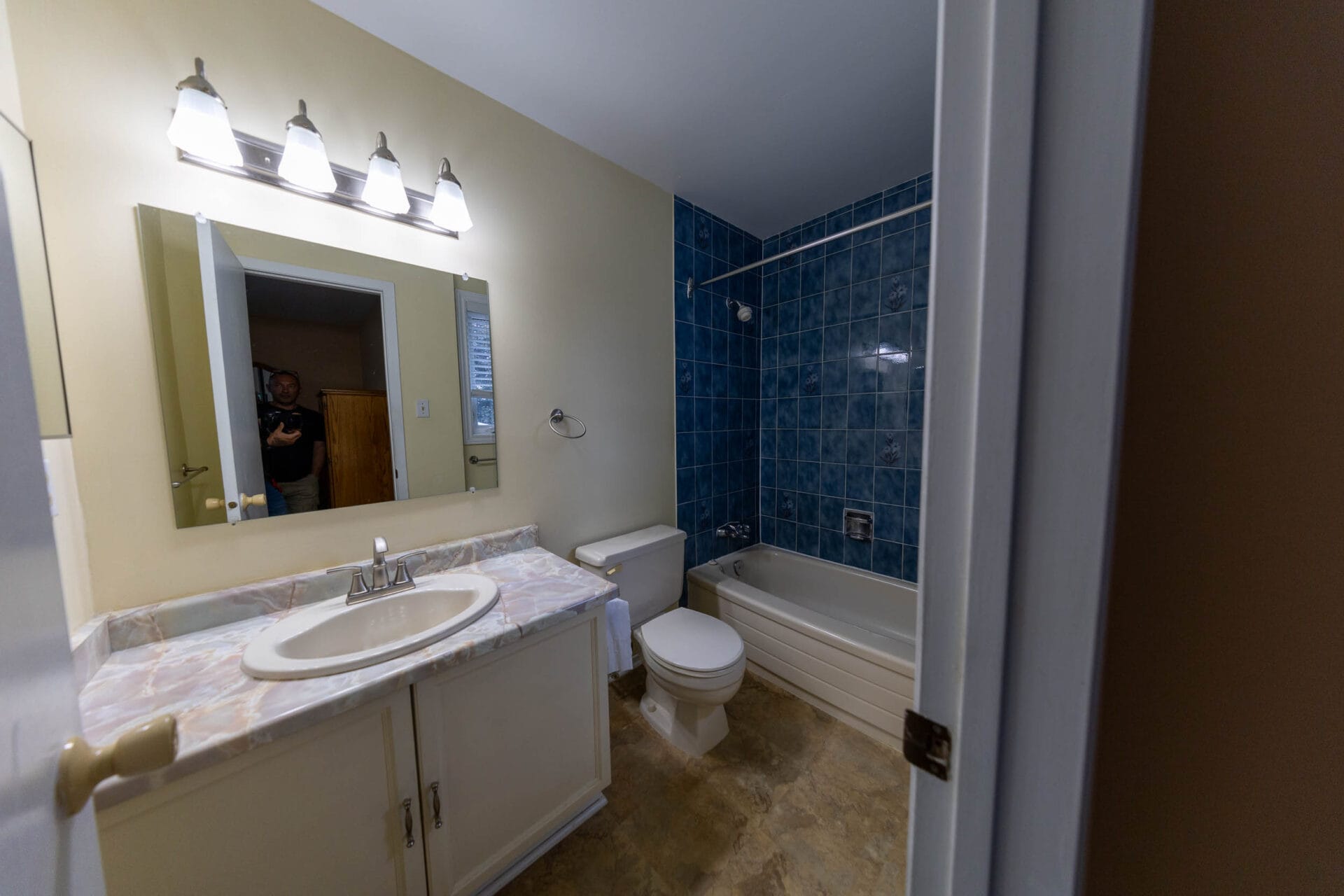
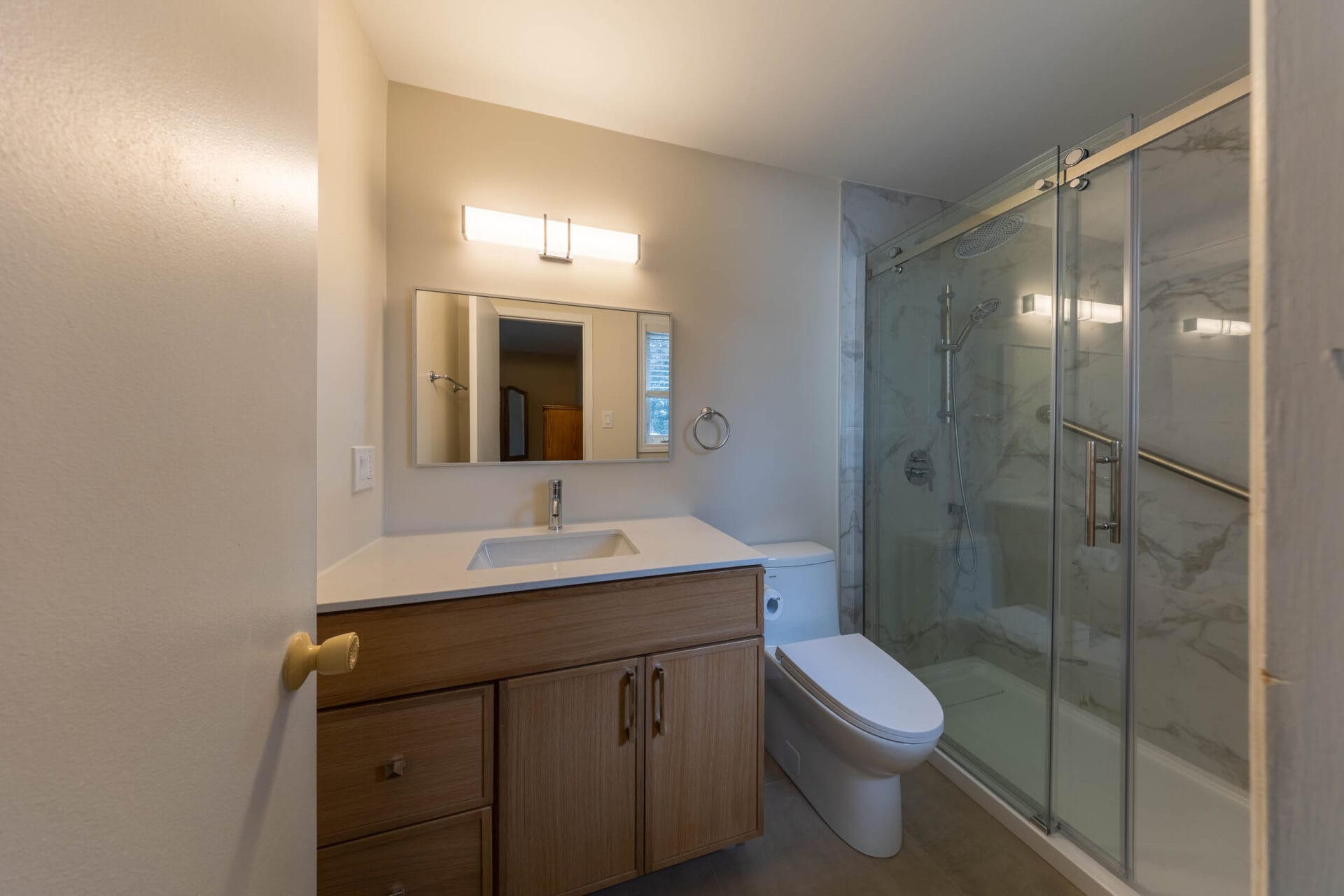
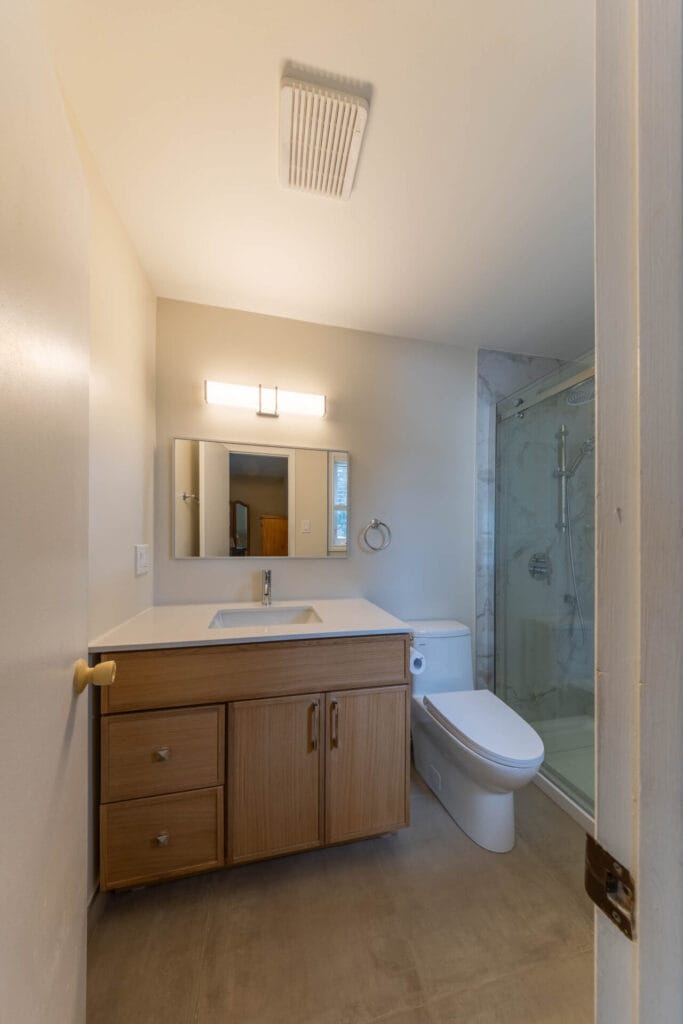
Yuri: Yes. So, um, basically what we’re looking at is an acrylic shower base made out of a high-density, thick acrylic. It’s actually made by OVE, a Montreal-based Canadian company. Then what you’re seeing is 24-by-24-inch ceramic tile. Those tiles can be used on both floors and walls. They are glazed, they are glossy, so it’s an excellent tile. I wouldn’t put it on the bathroom floor because of slippage, but for the wall they’re perfect because nothing sticks to them. You don’t have to do too much cleaning or maintenance. Excellent 24-by-24 tile. But we play with the pattern, so when you’re looking at the picture, it may look like one giant marble piece, which it is not. It consists of 24-by-24 tiles. And then what we have is a 10-millimetre glass door. One panel slides — the one on the right slides — and the one on the left stays fixed. And there are nice thick rollers, also by OVE. Then, like I said, there’s the Moen fold-down seat. We also use Bath Depot products often. For example, the mixing valve. And I always recommend a combination of a rain shower head and a handheld. It’s such an easy thing for both maintaining the shower and taking showers, having that combination. So inside the wall we have a mixing-valve kit from Bath Depot.
Ben: Right, and the vanity, because it looks like wood slats. Is that actual wood or a finish? And what’s the top made of?
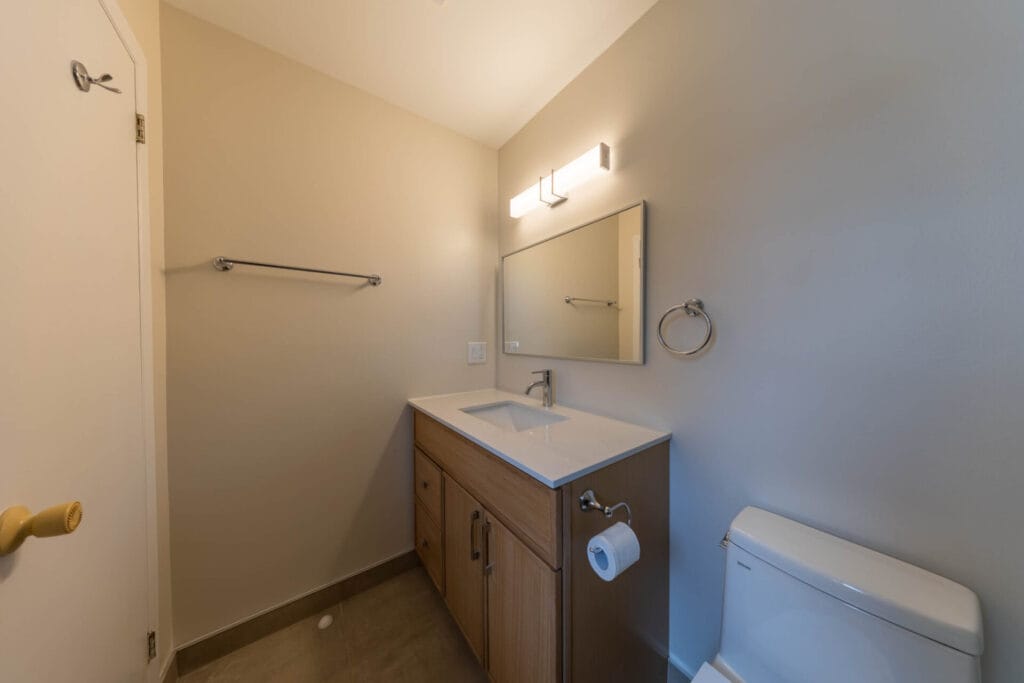
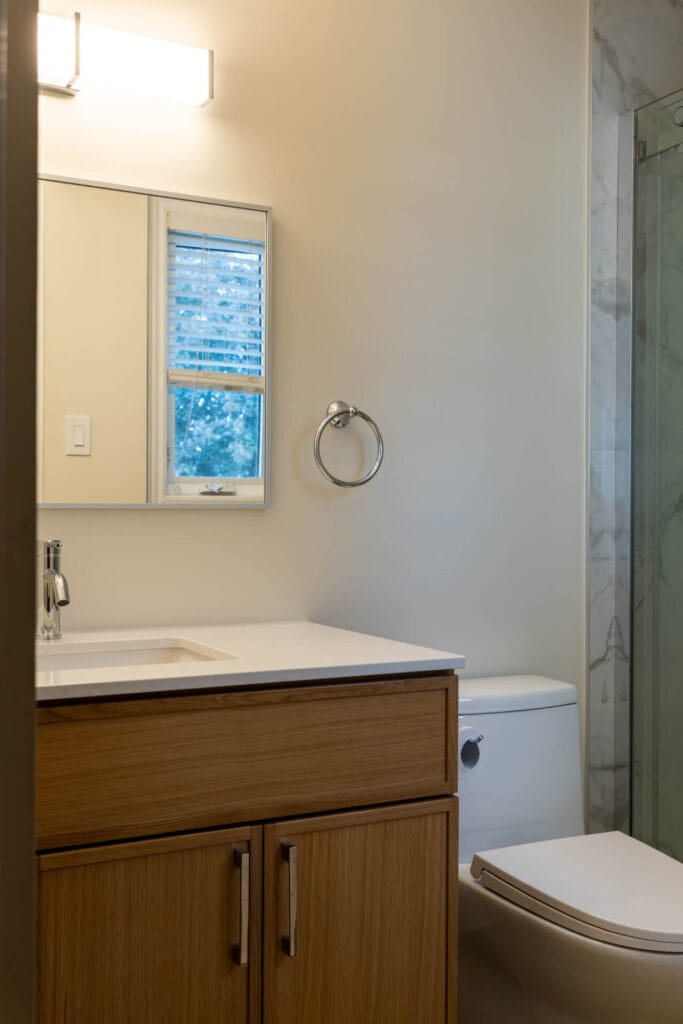
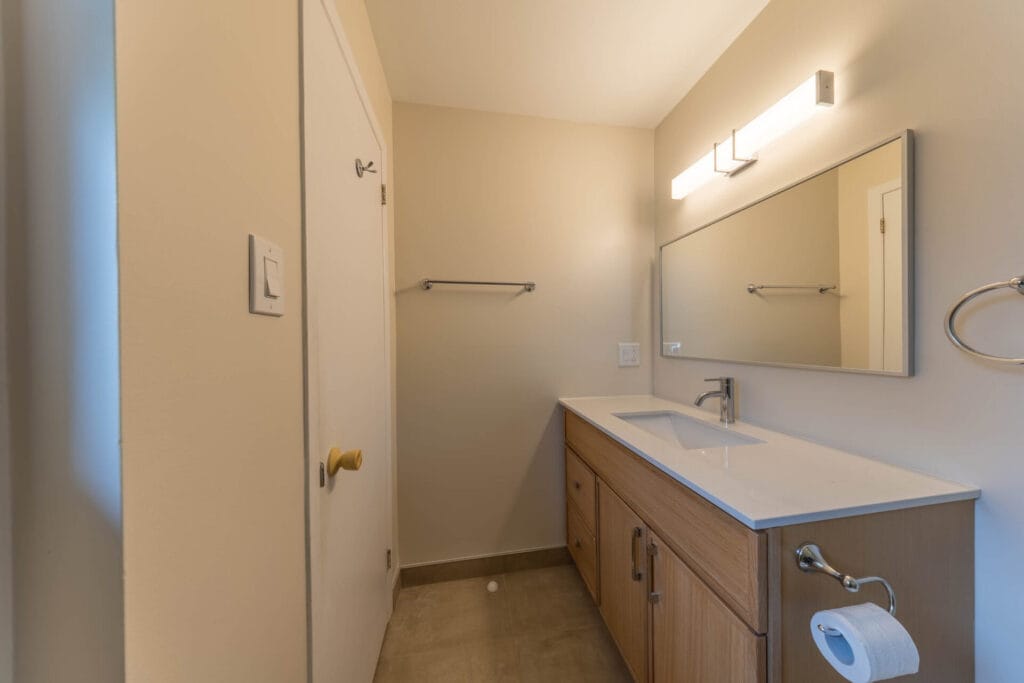
Yuri: Okay, so let’s jump into the vanity. I love that you’re asking me technical questions. We now have a new supplier, and we have access to both MDF with painted or thermofoil finishes, or — most of the vanities we’ve installed in the last year — solid wood, tongue-and-groove, full-extension, soft-close. And obviously the finish outside has edge banding; it’s an exterior finish that resembles wood grain. So the vanity is built out of plywood, and the outside finish has this modern interpretation of a Shaker style. The countertop is a one-piece quartz top with a ceramic undermount sink. It’s a very neutral quartz. We have various patterns, but we wanted to keep things light and simple. So: quartz top.
Ben: Good. I like neutral. Nothing is shouting at you. When you were picking all that with the customers, what was the vibe you wanted it to have?
Yuri: So any time customers — there’s a few ways that this works. Some customers choose to have their own materials and supply their own materials. Some customers put their trust in your humble servant, which is me, and they ask me for some advice. And oftentimes we supply and install materials, but they have a choice in it. So one of the things I do in those cases is work with the existing house. I look and see how the rest of the house looks. What kind of finishes do they have? Do they have chrome? What kind of features do they have? What colours? Carpet or hardwood? Based on that, I come with our mobile showroom and I bring samples of the tile, samples of the countertop, and samples of the products to their home. We’ll look in the van, then bring the tiles and the finish samples of the vanity doors into the existing bathroom. Lighting will change on some projects. We add lighting often in bathrooms. In this bathroom, the lighting stayed the same. We have a window and we have a light above the mirror, so it was pretty easy. We set the vanity door sample in the bathroom. We set the flooring sample — also a 24-by-24 porcelain grippy tile — and then we set the wall tile. We looked at it, the customers said they liked the combination, I noted it all down, and that’s kind of the choice process that customers go through.
Ben: Yeah, so it’s calm, cohesive, easy to live with. When you handed it back to the clients, what part of it felt like, “yeah, this is why we did it?” Was there a moment when you could see that relief from the client thinking “yea, actually works for us?”
Yuri: It was that, but it was not an avalanche. It was continuous. Every time I would come to the job site, they would meet me, offer me a coffee. They made cookies for the workers — for Roman and for Sergey, the helper — and they kept saying how hard they work and how happy they are with them. So the excitement and gratitude started long before the bathroom was completed, which I so thoroughly enjoy. And when I was done, I came with the camera and started taking pictures. They were standing around. It was so beautiful. I’m taking pictures, and she put her iPad on and played various music to entertain me. Again, offered me cookies and coffee. It’s beautiful. It was a good experience that culminated in a bathroom they love and can use safely. And now they’re more at home in their own home.
Ben: Yeah, that’s a lovely and very human ending. Just good work and a good feeling. Thank you, Yuri. I think that tells the story really well.
Yuri: Are you missing anything? In the beginning you wanted to ask about the head.
Ben: Right, yes. Can we go back to that? Because now that you mention it, we did skim over it. Talk to me about the shower system — rain head, handheld — how you decided on that, and why that combo works for people.
Yuri: No, no, no, no, no. Ben, I’m talking about something completely different. So I don’t know if we’re going to post this. Maybe this will get cut out of this interview, but one of the photos there, if you remember, is the photo of your humble servant sitting in the bathtub with a shower hat on my head. You were so curious about that one.
Ben: The shower cap?
Yuri: Yeah, the shower cap.
Ben: Right. Thank you for catching that. All right, let’s do it. The shower cap moment. Set that scene properly. What actually happened that day?
Yuri: Okay, I’ll go quick. So I show up with the big camera and tripod. I started taking those pictures of the existing bathroom. My guy, Roman, is there. I laugh with him. We always joke in the beginning. The customer is there, she’s laughing. And for the sake of humour and kicks and giggles, I climb in the tub and sit in a meditative pose and hum an “om” sound. She loves it. She runs away, she comes back with the hat, puts it on my head, saying, “There, there. That completes the picture.” I gave Roman the camera and he captured that picture. So this was just an off-the-cuff moment — call it a philosophical way of saying goodbye to the old and hello to the new.
Ben: Right. That is perfect. Keep that one. It’s human, it’s funny, it’s not staged marketing. It’s a real moment. And it says a lot about how you show up with people. Not many contractors would climb into the old tub in a shower cap.
Yuri: I think many should.
Ben: That’s a personal trademark. It’s your personality.
Yuri: Thank you, Ben. I hope that does not negate the value of what we try to do, and actually reminds both us as bathroom contractors, and our clients. At the end of the day, life is just a quick glimpse and we should not take it too seriously. Enjoy what’s in front of us, laugh often, smile often, and be grateful for the moments we have.
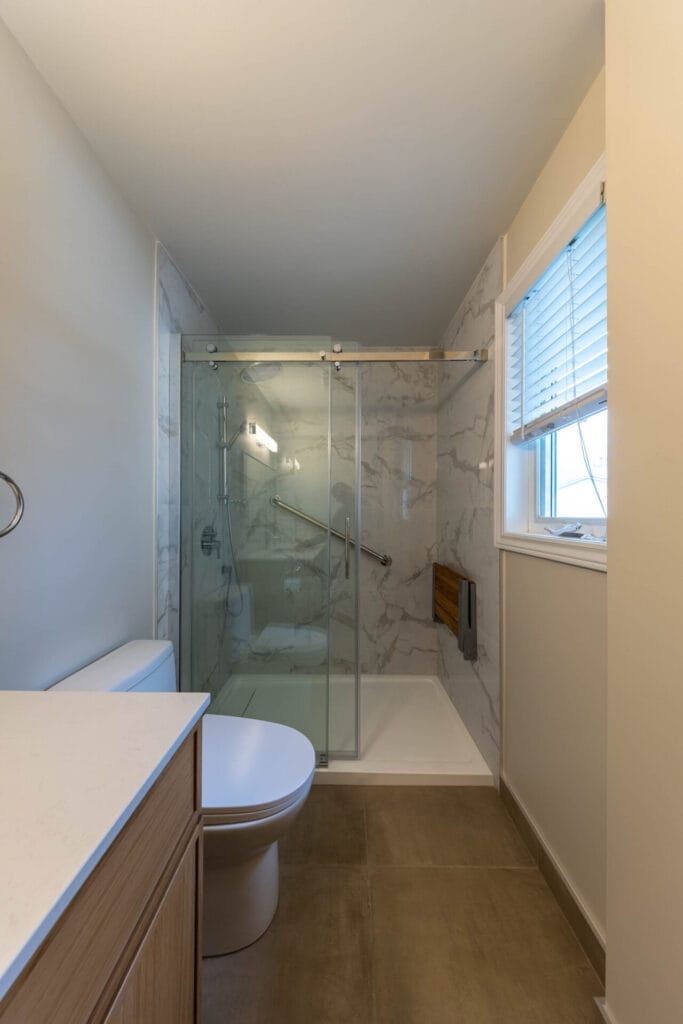
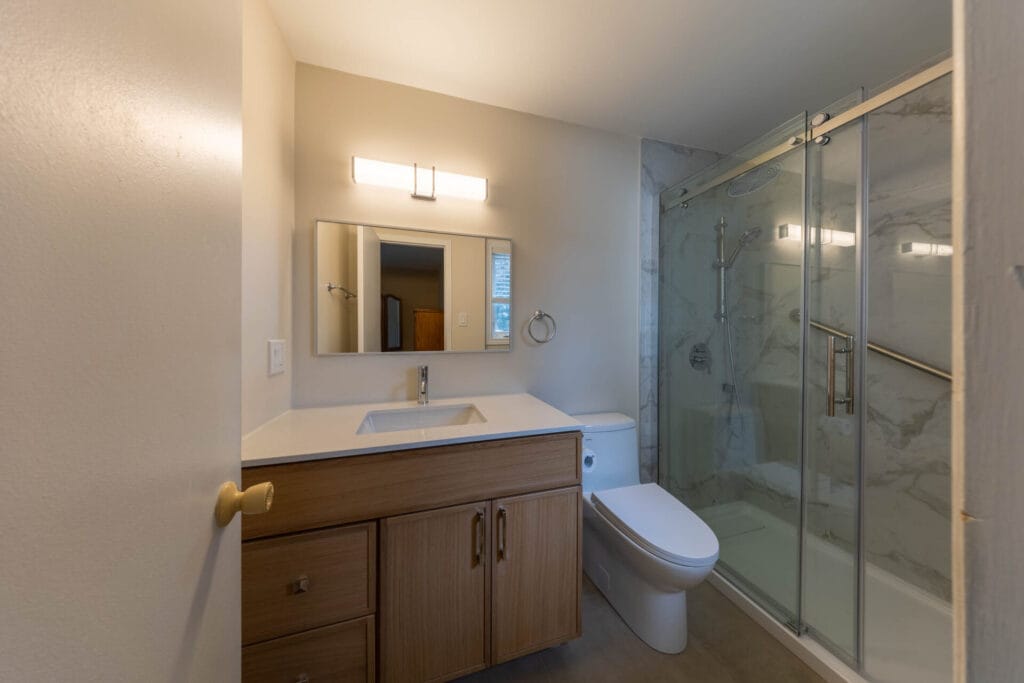
Barrhaven Tub-to-Shower Case Study
See how we transformed an older Barrhaven bathroom by replacing a difficult-to-enter bathtub with a safer low-threshold shower, grab bar, fold-down seat and practical modern finishes designed for easier everyday use.